
Liverpool city centre contains one of the densest concentrations of historic waterfront, civic, religious, and cultural landmarks in Britain. Its streets connect the growth of the Atlantic port, the Industrial Revolution, municipal reform, music history, migration, and modern heritage regeneration. For visitors, the compact geography of central Liverpool makes it possible to move between medieval street patterns, Georgian civic spaces, Victorian architecture, and world-famous museums within a short walking radius.
- Why is Liverpool city centre one of the most important historic visitor areas in England?
- Which attractions near Liverpool city centre should visitors prioritise first?
- How can visitors organise a walking route through Liverpool city centre attractions efficiently?
- What is the historical importance of the Royal Albert Dock and the Liverpool waterfront?
- Why are St George’s Hall and William Brown Street essential to understanding Liverpool’s civic history?
- What do Liverpool Cathedral and the Metropolitan Cathedral reveal about the city’s religious and social development?
- How does the Cavern Quarter connect Liverpool city centre to global music history?
- What museums near Liverpool city centre provide the strongest historical context for visitors?
- How did Liverpool city centre develop from medieval borough to modern visitor destination?
- What practical strategies help visitors see Liverpool city centre attractions in one day?
- Why does Liverpool city centre remain historically relevant for future visitors and researchers?
This guide explains how to visit Liverpool city centre attractions efficiently by placing the main sites in their historical and geographical context. It is designed for visitors who want a practical route through the city, but it also provides the deeper background needed by history enthusiasts, students, educators, and heritage readers. The article focuses on the attractions closest to Liverpool city centre and shows how they connect to the city’s long development from medieval borough to global port and cultural destination.
Why is Liverpool city centre one of the most important historic visitor areas in England?
Liverpool city centre combines a major maritime waterfront, a surviving commercial core, monumental civic architecture, nationally significant museums, and globally recognised music heritage within a compact walkable area. Its attractions reflect Liverpool’s medieval origins, eighteenth-century port growth, nineteenth-century imperial trade, and twentieth-century cultural influence.
Liverpool’s central district matters because it preserves several layers of British urban history in one continuous visitor landscape. The area includes the historic waterfront along the River Mersey, the commercial district around Castle Street and Dale Street, the cultural quarter around St George’s Hall and William Brown Street, the retail core around Church Street, and the dockland museums at the Royal Albert Dock. These districts developed at different moments, but they now function as one concentrated heritage zone.
The city’s rise began with its medieval borough foundation in 1207, when King John granted Liverpool a charter. For centuries it remained a modest port, but in the late seventeenth and eighteenth centuries it expanded rapidly through Atlantic commerce. By the nineteenth century Liverpool had become one of the world’s leading ports, handling imports and exports on an enormous scale and acting as a gateway for passengers, migrants, shipping firms, railway traffic, and mercantile finance. The architecture of the city centre reflects that prosperity. Warehouses, exchange buildings, churches, banks, offices, and public institutions were built to serve a city with global economic reach.
The central visitor area is also important because it contains institutions that explain Liverpool’s social and cultural history, not just its architecture. Museums on the waterfront interpret the city’s role in maritime trade, migration, and the transatlantic slave economy. The Cavern Quarter and nearby streets preserve the modern music legacy associated with The Beatles and Merseybeat. St George’s Hall and the surrounding civic quarter demonstrate Victorian municipal ambition. Liverpool Cathedral and the Metropolitan Cathedral show the city’s twentieth-century religious and architectural development.
For travellers, this concentration creates unusual efficiency. The waterfront, museums, commercial core, and major public buildings sit within walking distance of Liverpool Lime Street station and Liverpool ONE. A visitor can move from Roman Catholic modernism to dock engineering, then to Georgian planning and music heritage, in a single day without leaving the centre.
Which attractions near Liverpool city centre should visitors prioritise first?
Visitors should prioritise the Royal Albert Dock, the Pier Head waterfront, St George’s Hall, the Walker Art Gallery area, Liverpool Cathedral, the Cavern Quarter, and central museum collections. These sites provide the clearest overview of Liverpool’s maritime, civic, religious, artistic, and musical history in a manageable route.
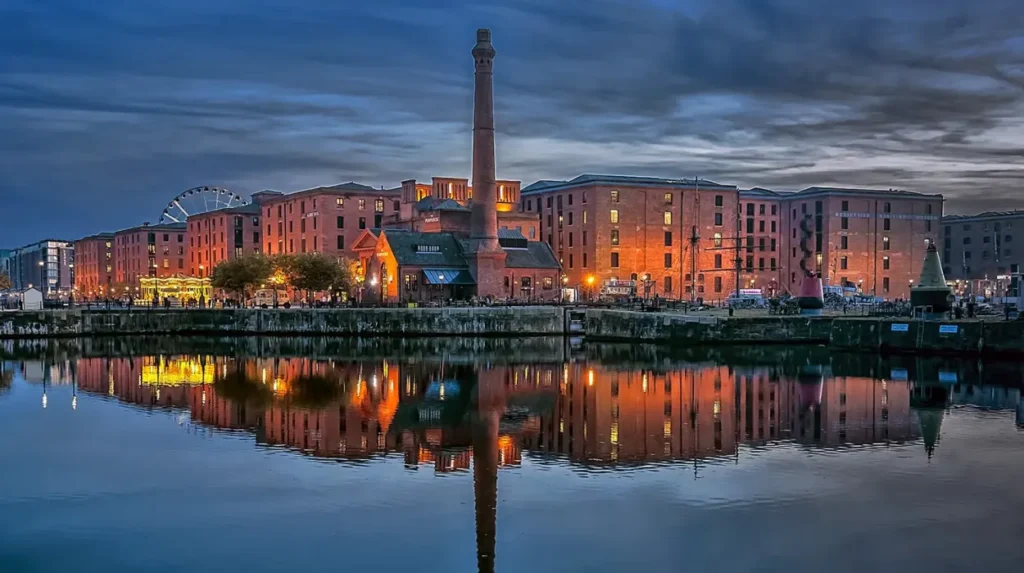
The best first priority is the historic waterfront because it explains why Liverpool became internationally important. The Royal Albert Dock, opened in 1846, was designed by Jesse Hartley and Philip Hardwick and represented a major engineering achievement. It was the first structure in Britain built from cast iron, brick, and stone without structural timber in its warehouses, reducing fire risk in a working dock environment. The complex linked secure storage, shipping operations, and customs handling in a single integrated space. Today it houses museums, restaurants, and public space, but its original form still communicates the commercial scale of nineteenth-century Liverpool.
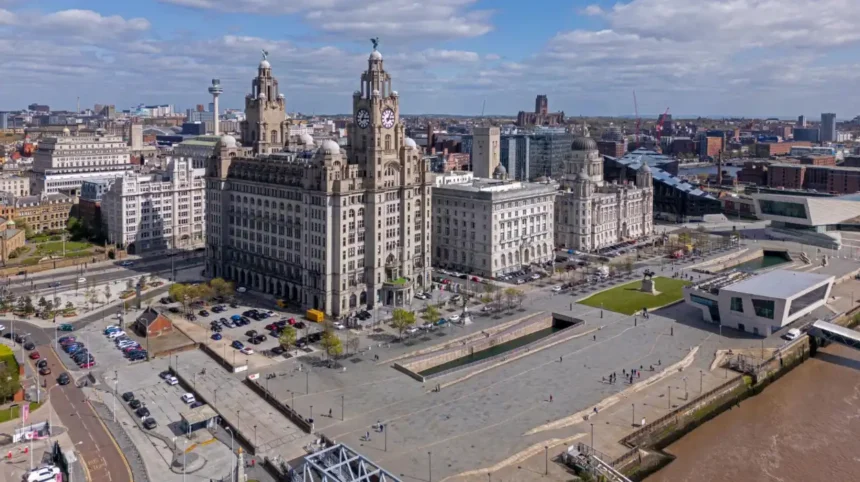
From the Albert Dock, visitors can walk north along the waterfront to Pier Head. This area contains the Three Graces: the Royal Liver Building, completed in 1911; the Cunard Building, completed in 1917; and the Port of Liverpool Building, completed in 1907. Together they form Liverpool’s best-known civic and commercial skyline. They represent the city’s shipping, insurance, and port administration sectors at the height of its twentieth-century maritime importance.
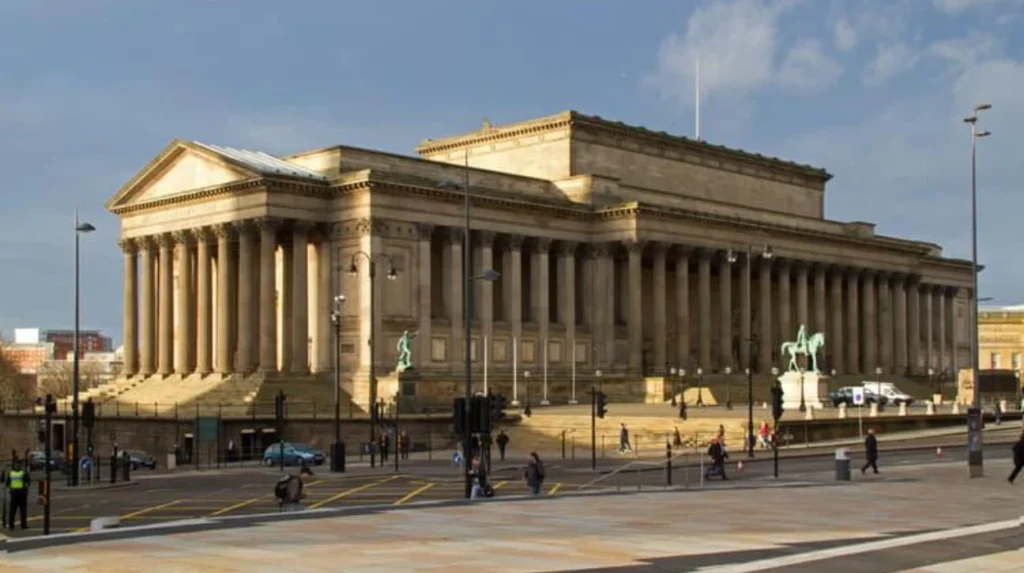
A second priority is the civic quarter around St George’s Hall and William Brown Street. St George’s Hall opened in 1854 and remains one of Britain’s finest neoclassical public buildings. Designed by Harvey Lonsdale Elmes, it combined law courts, concert facilities, and ceremonial space in one monumental structure. Nearby are the Walker Art Gallery, the World Museum, the Central Library, and the Wellington Column. This cluster offers a compact introduction to Liverpool’s nineteenth-century public culture, philanthropy, and municipal confidence.
A third priority is Liverpool’s religious architecture. Liverpool Cathedral, designed principally by Giles Gilbert Scott, was begun in 1904 and completed in stages across the twentieth century. It is one of the largest cathedrals in the world and dominates the city skyline from St James’s Mount. The Metropolitan Cathedral of Christ the King, completed in 1967 to a design by Frederick Gibberd, stands a short distance away and contrasts sharply with the Gothic revival character of the Anglican cathedral. Together they show how Liverpool’s religious, demographic, and architectural history developed across different eras.
The Cavern Quarter and Mathew Street deserve priority because they anchor Liverpool’s global reputation in modern music. The Cavern Club site became associated with early performances by The Beatles in the early 1960s and sits within a wider landscape of music tourism, statues, pubs, performance venues, and interpretive sites. It is not Liverpool’s oldest heritage asset, but it is one of the city’s most internationally recognised.
How can visitors organise a walking route through Liverpool city centre attractions efficiently?
The most efficient route begins at St George’s Hall and William Brown Street, moves downhill through the commercial core and Cavern Quarter, continues to the Pier Head waterfront, then finishes at the Royal Albert Dock and nearby museums. Cathedral visits work best as a morning extension or a separate uphill loop.
Efficient sightseeing in Liverpool depends on understanding the city’s topography and transport nodes. Liverpool Lime Street station sits at the eastern edge of the central core beside St George’s Hall, making the civic quarter the most logical starting point for many rail visitors. From Lime Street, the route westward descends toward Castle Street, the Town Hall area, the Cavern Quarter, and the waterfront. This natural gradient helps reduce unnecessary backtracking.
A practical historical walking sequence begins at St George’s Hall, the World Museum, Walker Art Gallery, and Central Library. These sites stand within a few minutes of each other on William Brown Street. This district explains Victorian Liverpool’s investment in culture, education, law, and civic display. It also gives visitors a clear visual introduction to the scale of nineteenth-century municipal architecture before they move into the older commercial streets.
From there, visitors should continue toward Church Street and the commercial district. Castle Street, Water Street, and Dale Street preserve the business geography of mercantile Liverpool. The Town Hall, originally built in the mid-eighteenth century and later remodelled, represents the city’s commercial authority and political self-confidence during the period of port expansion. The surrounding street pattern retains the atmosphere of Liverpool’s business core, where merchants, brokers, insurers, and shipping firms operated.
The next efficient stop is the Cavern Quarter around Mathew Street. This is geographically close to the business district and forms a useful transition between mercantile Liverpool and twentieth-century popular culture. From Mathew Street, visitors can continue directly downhill toward the Pier Head waterfront, where the Three Graces and ferry terminal sit.
The route then naturally extends south to the Royal Albert Dock. This section includes the Museum of Liverpool, the waterfront public realm, dockside warehouses, and museum collections such as the Merseyside Maritime Museum and Tate Liverpool when open exhibitions are scheduled. This final section works well because it allows visitors to end the day beside restaurants, open quays, and transport links.
Liverpool Cathedral and the Metropolitan Cathedral require a slight detour to the south-east of the commercial core. Visitors with a full day should add them in the morning before descending into the city centre. Visitors with less time should keep the waterfront-civic route as the core itinerary and treat the cathedrals as a second circuit. To experience this historic landmark in person today, consult our comprehensive [How to Visit Liverpool City Centre Attractions Efficiently] for itineraries and visiting parameters.
What is the historical importance of the Royal Albert Dock and the Liverpool waterfront?
The Royal Albert Dock and Liverpool waterfront explain the city’s nineteenth-century power as a global port. They preserve advanced dock engineering, warehouse design, customs systems, shipping administration, and public buildings linked to Atlantic trade, migration, empire, and industrial commerce across the British world.
The waterfront is the key to understanding Liverpool. The city’s modern growth was inseparable from the River Mersey and the dock system built along it. Before the eighteenth century, Liverpool was a relatively small port. Its expansion accelerated after the construction of the world’s first commercial enclosed wet dock in 1715, usually known as the Old Dock. That innovation allowed ships to remain afloat at varying tide levels and improved the handling of cargo in a port environment shaped by the Mersey’s tidal range.
The Albert Dock belonged to a later phase of dock development. Opened in 1846, it was part of a huge nineteenth-century dock network that extended along the Liverpool waterfront. The dock’s integrated warehouses allowed goods to be unloaded, stored, and processed efficiently. The structure’s use of cast iron columns and brick vaulting reduced the fire risks associated with timber-framed dock warehouses. This mattered because Liverpool handled cotton, tobacco, sugar, grain, timber, and many other valuable cargoes that required secure storage.
The waterfront also reflects the city’s connection to the Atlantic economy. Liverpool played a major role in the transatlantic slave trade during the eighteenth century, and the wealth generated by that system shaped parts of the city’s commercial expansion. Modern interpretation at Liverpool museums addresses this history directly. The city was also a major departure point for migrants, especially in the nineteenth century, when millions of passengers travelled through Liverpool to North America and elsewhere. Shipping lines, ticketing agents, and port authorities all left their mark on the central waterfront.
Pier Head demonstrates how the port economy evolved in the late nineteenth and early twentieth centuries. The Three Graces symbolised corporate and administrative power rather than warehouse logistics. The Royal Liver Building was built for the Royal Liver Assurance group. The Cunard Building served one of the most famous transatlantic shipping companies. The Port of Liverpool Building represented the Mersey Docks and Harbour Board. Together they show how Liverpool’s waterfront shifted from dockside handling to the broader systems of finance, insurance, passenger transport, and port governance that sustained maritime commerce.
Why are St George’s Hall and William Brown Street essential to understanding Liverpool’s civic history?
St George’s Hall and William Brown Street are essential because they show how nineteenth-century Liverpool used architecture, libraries, museums, and law courts to express municipal power, public education, cultural ambition, and urban prestige during the city’s period of extraordinary commercial wealth and population growth.
St George’s Hall is one of the most important civic buildings in Britain. It was designed after a competition in 1839 and opened in 1854. Harvey Lonsdale Elmes, the young architect who won the competition, created a vast neoclassical structure that housed assize courts, crown courts, concert facilities, and grand public rooms. Its design answered practical needs, but it also made a statement about Liverpool’s status. This was a city rich enough and confident enough to build at monumental scale.
The hall’s interior remains central to its significance. The Great Hall, with its Minton tile floor and large barrel-vaulted volume, functioned as a ceremonial and cultural space. The law courts reflected Liverpool’s role as a major urban centre requiring a formal judicial infrastructure. The combination of music, law, and ceremony in one building reveals the Victorian belief that public architecture should represent both civic order and moral seriousness.
William Brown Street strengthens this civic story because it groups several public institutions in a single processional setting. William Brown, a merchant and philanthropist, funded the library and museum buildings that helped shape the area. The Walker Art Gallery, opened in 1877, became one of the country’s major public art collections outside London. The World Museum developed from nineteenth-century collecting traditions in natural history, archaeology, ethnography, and science. Liverpool Central Library, substantially remodelled in the twenty-first century, continues the educational mission of the district.
This cluster reflects a broader nineteenth-century pattern. Industrial and port cities often invested in museums, galleries, and libraries to demonstrate public virtue and civic maturity. In Liverpool, these institutions also served a rapidly growing urban population. The city’s population increased from roughly 77,000 in 1801 to more than 685,000 by 1901. Public institutions were part of the municipal response to that scale of growth. They provided knowledge, prestige, and social infrastructure in a city transformed by trade and migration.
What do Liverpool Cathedral and the Metropolitan Cathedral reveal about the city’s religious and social development?
Liverpool’s two cathedrals reveal the city’s scale, denominational diversity, migration history, and twentieth-century architectural ambition. The Anglican cathedral reflects monumental Gothic revival planning, while the Metropolitan Cathedral expresses post-war Catholic renewal in a city shaped by Irish migration and expanding urban congregations.
Liverpool Cathedral stands on St James’s Mount and dominates the skyline from many points in the city centre. The cathedral was designed by Giles Gilbert Scott after a competition held in 1902. Construction began in 1904 and continued across much of the twentieth century, with the building consecrated in stages before final completion in 1978. Its scale reflects the ambition of the Church of England in a major industrial city, but it also reflects Liverpool’s self-image during the late imperial period.
The building is significant architecturally because it adapts Gothic forms to modern engineering and a long construction programme. Its tower, nave, and elevated position create one of the strongest urban silhouettes in England. The cathedral precinct also includes St James’s Cemetery, a dramatic former quarry landscape that adds historical depth to the site.
The Metropolitan Cathedral of Christ the King tells a different story. Liverpool’s Roman Catholic population grew substantially in the nineteenth century, especially because of Irish migration during and after the Great Famine of the 1840s. Catholic institutions expanded across the city. Plans for a major Catholic cathedral existed before the Second World War, including an earlier design by Edwin Lutyens, but that vast scheme was never completed. The modern cathedral that stands today was designed by Frederick Gibberd and opened in 1967.
Its circular plan, lantern tower, and modern materials make it one of the most distinctive post-war religious buildings in Britain. It is not only a place of worship but also evidence of Liverpool’s demographic history, especially the strength of Catholic communities in the city. Taken together, the two cathedrals show how religion, migration, class, and architecture shaped modern Liverpool.
How does the Cavern Quarter connect Liverpool city centre to global music history?
The Cavern Quarter connects Liverpool city centre to global music history through its association with The Beatles, Merseybeat, post-war youth culture, and the city’s entertainment economy. It preserves the symbolic geography of Liverpool’s 1960s music explosion within the wider historic commercial centre.
The Cavern Quarter is centred on Mathew Street, a narrow street within Liverpool’s old commercial district. The original Cavern Club opened in 1957 in a former warehouse cellar. It initially hosted jazz performances, but it became closely associated with the beat music scene of the early 1960s. The Beatles performed there many times before achieving international success, and the venue later became a focal point in the city’s global music identity.
The significance of the quarter goes beyond one club. Liverpool’s music culture emerged from a wider social environment shaped by post-war reconstruction, youth leisure, transatlantic cultural exchange, and the city’s port connections. Sailors and travellers brought American records into Liverpool. Dance halls, clubs, and local promoters helped circulate rhythm and blues, rock and roll, skiffle, and beat music. The city’s compact centre allowed musicians, audiences, record shops, and venues to interact closely.
The present Cavern Quarter is partly reconstructed and partly interpretive. The original Cavern Club site was affected by redevelopment in the 1970s, and the current venue includes rebuilt sections close to the original location. For heritage purposes, this means the quarter should be understood as both an authentic place and a commemorative landscape. Statues, plaques, performance spaces, and themed businesses reinforce its role in Liverpool’s visitor economy.
For efficient sightseeing, the Cavern Quarter works best as a short but important stop between the civic quarter and the waterfront. It adds a twentieth-century cultural layer to an itinerary otherwise dominated by nineteenth-century architecture and maritime history.
What museums near Liverpool city centre provide the strongest historical context for visitors?
The Museum of Liverpool, Merseyside Maritime Museum, International Slavery Museum, World Museum, and Walker Art Gallery provide the strongest historical context. Together they explain Liverpool’s urban growth, maritime economy, global connections, migration patterns, slavery legacies, scientific collecting, and civic culture through accessible public collections.
The Museum of Liverpool at Mann Island is the best starting point for visitors who want a broad narrative of the city. It interprets Liverpool’s social history, transport, sport, waterfront development, and cultural identity. Its location beside the Pier Head also makes it easy to integrate with a walking route. The museum is especially useful because it links physical landmarks to wider themes such as housing, labour, migration, and everyday urban life.
The Merseyside Maritime Museum, located at the Albert Dock, is central to understanding Liverpool’s port history. Its collections address shipping technology, trade routes, naval history, and passenger movement. They also interpret the Titanic’s Liverpool connections, even though the ship was registered in Liverpool rather than sailing from it on its maiden voyage. This museum helps visitors understand how maritime infrastructure shaped the city’s economy and built environment.
The International Slavery Museum, also based at the Albert Dock, is one of the most important institutions in Britain for interpreting the history and legacies of transatlantic slavery. Liverpool was heavily involved in the slave trade during the eighteenth century, and any accurate account of the city’s rise must include that fact. The museum places Liverpool’s local history within a broader Atlantic and African diaspora context and addresses the continuing consequences of slavery and racism.
The World Museum and Walker Art Gallery add wider intellectual and cultural context. The World Museum includes archaeology, natural history, and world cultures, allowing educators and students to connect Liverpool’s collecting institutions to imperial trade networks, scientific classification, and nineteenth-century museum culture. The Walker Art Gallery demonstrates the role of public art patronage in a prosperous commercial city.
How did Liverpool city centre develop from medieval borough to modern visitor destination?
Liverpool city centre developed through five major phases: medieval borough formation, eighteenth-century port expansion, nineteenth-century dock and civic growth, twentieth-century commercial restructuring, and late twentieth-century heritage regeneration. Each phase reshaped streets, landmarks, institutions, and visitor use of the central urban landscape.
The first phase was medieval formation. Liverpool was granted its borough charter by King John in 1207. The settlement developed around a pool inlet, a market area, and a small street network near the river. It remained modest for several centuries, overshadowed by larger regional centres such as Chester. However, the medieval street pattern influenced the later development of the commercial core.
The second phase was eighteenth-century port expansion. Liverpool’s role in Atlantic trade transformed its economy. New docks, merchant houses, and commercial institutions appeared. The Old Dock, opened in 1715, was a turning point in port engineering. The town expanded inland and along the waterfront. Financial wealth from overseas commerce, including trade linked to slavery, helped fund urban development.
The third phase was nineteenth-century growth. This was the period in which much of the city centre visitors see today took shape. Dock construction accelerated, railways linked Liverpool to manufacturing districts, warehouses multiplied, and public institutions were built at monumental scale. Population growth created new housing pressures and social inequalities, but it also generated civic investment in museums, libraries, roads, and public buildings. St George’s Hall, the Albert Dock, commercial offices, and many churches belong to this period.
The fourth phase was twentieth-century restructuring. Liverpool remained an important port, but changing shipping methods, global economic shifts, containerisation, and wartime damage altered the city’s economy. Some older dock areas declined. Commercial patterns changed, and parts of the centre were redeveloped. Music culture, football identity, and broadcasting gave Liverpool new forms of international recognition beyond shipping.
The fifth phase was heritage regeneration. Late twentieth-century and early twenty-first-century investment transformed the waterfront and central districts into a mixed landscape of museums, public space, retail, and tourism. The Albert Dock was redeveloped from the 1980s onward. Liverpool’s designation as European Capital of Culture in 2008 accelerated public attention and investment. Although UNESCO removed Liverpool Maritime Mercantile City from the World Heritage List in 2021 after concerns over waterfront development, the underlying historic significance of the central area remains substantial.
What practical strategies help visitors see Liverpool city centre attractions in one day?
Visitors can see Liverpool city centre attractions in one day by grouping sites into three zones: the civic quarter, the commercial and music core, and the waterfront. Prioritising walkable clusters, booking timed museum visits, and reserving cathedral visits for separate blocks reduces backtracking.
A one-day visit works best when visitors treat Liverpool city centre as a sequence of connected districts rather than a random list of attractions. The first zone is the civic quarter around Lime Street and William Brown Street. This includes St George’s Hall, the World Museum, Walker Art Gallery, and Central Library. Starting here is efficient for rail arrivals and gives immediate access to indoor attractions that open during the morning.
The second zone is the commercial and music core. Visitors should walk west through Church Street toward Castle Street, the Town Hall area, and the Cavern Quarter. This part of the route introduces mercantile Liverpool, eighteenth-century and nineteenth-century business architecture, and the modern music legacy associated with Mathew Street. It also passes through active retail and food areas, making it a practical midday segment.
The third zone is the waterfront. Pier Head, the Museum of Liverpool, and the Royal Albert Dock can be covered together. This section provides the strongest combination of historic buildings, museum interpretation, public space, and views across the Mersey. If time is limited, visitors should choose one or two museums rather than attempting every gallery. The Museum of Liverpool plus one Albert Dock museum is a realistic combination.
Cathedral visits should be planned carefully because they sit uphill from the central westward route. Visitors who value architecture and panoramic views should start early at the cathedrals, then descend into the city core. Visitors focused mainly on docks and museums can omit the cathedral circuit from a one-day schedule and reserve it for a second visit.
Walking is usually the best way to understand the relationship between Liverpool’s attractions. Distances in the centre are manageable, and the street transitions reveal how civic, commercial, religious, and maritime zones connect. A route-based approach also improves historical understanding because the visitor experiences the city in roughly the same sequence that its urban functions developed: institutional core, mercantile streets, then the riverfront that drove Liverpool’s expansion.
Why does Liverpool city centre remain historically relevant for future visitors and researchers?
Liverpool city centre remains historically relevant because it preserves evidence of port urbanism, imperial commerce, migration, slavery, religion, municipal culture, and popular music within a compact environment. Its buildings, museums, archives, and street patterns continue to support public history, teaching, tourism, and heritage research.
The long-term value of Liverpool city centre lies in the range of historical questions it can answer. For historians of trade, it offers evidence of port engineering, mercantile administration, and Atlantic exchange. For scholars of migration, it documents one of Britain’s great passenger gateways. For researchers studying the British Empire, it demonstrates how overseas commerce shaped urban wealth, public institutions, and architectural patronage. For music historians, it provides the urban setting of one of the twentieth century’s most influential popular music scenes.
The area also remains relevant because preservation and redevelopment continue to shape public debate. Historic cities are not fixed museum objects. Liverpool’s central landscape has been altered repeatedly by commerce, war, planning, conservation, and tourism. The balance between development and preservation remains active. The city’s former World Heritage status, later removal from the UNESCO list, and continuing waterfront change all show that heritage management is a live policy issue rather than a settled one.
For educators, the city centre is unusually useful because it allows multiple historical themes to be taught through a single field visit. Students can examine industrialisation, architecture, slavery, migration, religion, and cultural memory in one walkable environment. For genealogical researchers, Liverpool matters because the port, shipping firms, churches, and municipal records connect to family histories across Britain, Ireland, North America, and the wider former empire.
For visitors, this historical relevance has a practical outcome. Liverpool city centre is not simply a collection of attractions. It is a structured urban archive. The waterfront explains commerce. The civic quarter explains public ambition. The cathedrals explain faith and migration. The Cavern Quarter explains cultural reinvention. Together, they make Liverpool one of the most efficient and historically rewarding city-centre visitor destinations in England.
What are the best attractions near Liverpool city centre?
The best attractions near Liverpool city centre include the Royal Albert Dock, St George’s Hall, Liverpool Cathedral, Metropolitan Cathedral of Christ the King, the Cavern Club, and the waterfront museums around Pier Head.