

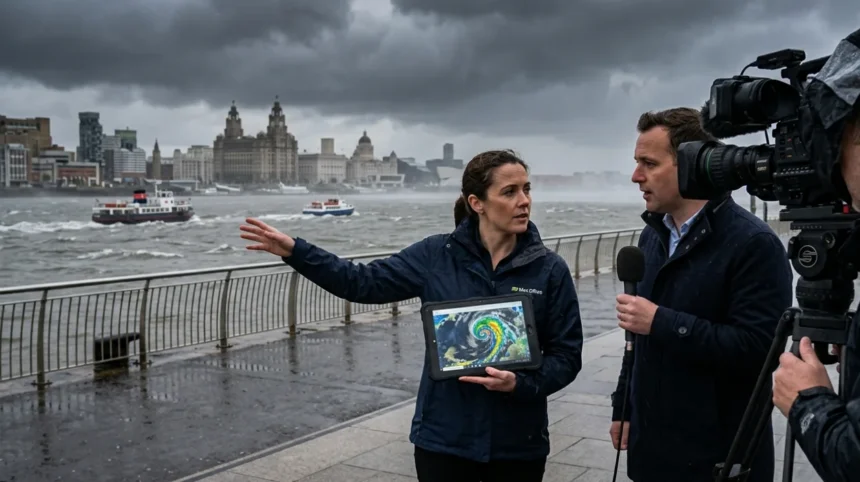
Weather is the state of the atmosphere at a specific time and place, characterized by variables including temperature, moisture, wind velocity, and barometric pressure. It represents the short-term fluctuations of the atmospheric boundary layer over minutes, hours, or days.
The planetary atmosphere operates as a dynamic, fluid system driven by thermodynamic imbalances. The unequal heating of the Earth by solar radiation produces temperature differentials across regions. These differentials alter atmospheric density, creating high-pressure systems and low-pressure systems. Air masses naturally migrate from high-pressure cells to low-pressure cells to achieve equilibrium, generating wind patterns that transport moisture and thermal energy.
The planetary hydrologic cycle dictates moisture variations in the atmosphere. Water evaporates from surface bodies, rises as water vapor, and cools as it ascends into lower-pressure altitudes. This cooling leads to condensation, creating cloud formations. Further condensation causes water droplets or ice crystals to fall to the surface as precipitation. Microscale interactions among these thermal and moisture variables determine the immediate atmospheric conditions experienced at ground level.
Distinguishing weather from climate requires an understanding of temporal scale. Weather describes immediate, highly volatile atmospheric phenomena occurring within brief periods. Climate represents the statistical integration of those phenomena over extended eras. The World Meteorological Organization defines the standard baseline for climate assessment as a 30-year average of localized meteorological data. While weather dictates daily operational conditions, climate establishes long-term environmental patterns.
How did atmospheric science develop historically?
Atmospheric science developed through a transition from speculative philosophy to empirical measurement, accelerated by the invention of standardized instruments in the seventeenth century and the deployment of thermodynamic models, satellite observation networks, and numerical computing systems in the twentieth century.
Early records of atmospheric tracking date to ancient civilizations. Babylonian astronomers analyzed cloud formations to project short-term changes. In 350 BCE, the philosopher Aristotle authored Meteorologica, a foundational treatise that categorized atmospheric phenomena into three elements: fiery, airy, and watery. This philosophical framework endured for two millennia despite lacking empirical validation or precise instrumentation.
The scientific revolution transformed atmospheric analysis through the invention of key physical sensors. In 1593, Galileo Galilei constructed the thermoscope, the precursor to the thermometer. In 1643, Evangelista Torricelli invented the mercury barometer, proving that air possesses mass and exerts quantifiable pressure on the terrestrial surface. In 1780, Horace-Bénédict de Saussure built the hair hygrometer to measure relative humidity, establishing the foundational datasets needed for modern physical meteorology.
The mid-nineteenth century introduced systematic weather data gathering. The creation of the electric telegraph by Samuel Morse in 1837 enabled the instantaneous transmission of observational reports from widespread locations. In 1854, the United Kingdom Board of Trade established the Meteorological Department under Robert FitzRoy, initiating the first standardized coastal storm warning networks. This era marked the birth of the synoptic weather chart, which mapped concurrent atmospheric pressures across vast geographical zones.
The twentieth century established modern computational forecasting. In 1922, Lewis Fry Richardson published a mathematical framework for numerical weather prediction, though manual processing limitations prevented real-time execution. In 1950, Jule Charney and John von Neumann utilized the ENIAC electronic computer to run the first automated atmospheric model. The launch of the TIROS-1 satellite by the United States in 1960 introduced orbital remote sensing, completing the evolution into a globally monitored planetary science.
What components comprise the atmospheric system?
The atmospheric system comprises six fundamental physical variables: air temperature, barometric pressure, atmospheric humidity, precipitation types, wind velocity vectors, and cloud cover metrics. These variables interact continuously within the troposphere to generate all terrestrial weather phenomena.
Air temperature measures the kinetic energy of gas molecules in the atmosphere. This energy depends on solar irradiance, surface albedo, and geographic latitude. Variations in temperature alter air density, causing warm air to ascend and cold air to descend. This vertical displacement drives the convective currents responsible for localized thermal variations, turbulence, and the development of storm systems.
Barometric pressure represents the force exerted by the weight of the overhead atmospheric column. Measured in hectopascals or millibars, pressure gradients drive horizontal air movement. High-pressure systems generally suppress vertical air movement, producing stable conditions. Low-pressure systems encourage atmospheric ascent, inducing moisture condensation and unstable weather.
Atmospheric humidity defines the mass of water vapor present within a unit volume of air. Meteorologists evaluate this via relative humidity, which is the ratio of current vapor pressure to saturation vapor pressure at a specific temperature. High humidity levels provide latent heat energy, which fuels severe convective storms, hurricanes, and heavy precipitation events when air masses cool to their dew point.
Precipitation types occur when condensed atmospheric water vapor falls to the Earth under gravity. Liquid forms include rain and drizzle, which develop when ambient temperatures remain above 0 °C throughout the vertical column. Solid forms include snow, sleet, and hail. Sleet develops when melting snow refreezes in a cold surface boundary layer. Hail forms via intense updrafts in convective clouds that repeatedly lift water droplets into freezing altitudes.
Wind velocity vectors denote the horizontal motion of air relative to the surface of the Earth. Wind occurs due to spatial pressure gradient forces, modified by the Coriolis effect and surface friction. Anemometers measure wind speed, while wind vanes determine direction. Wind redistributes moisture and thermal energy across latitudes, directly driving global atmospheric circulation patterns.
Cloud cover metrics assess the fraction of the celestial hemisphere obscured by condensation products. Clouds are categorized into three altitude levels: high, middle, and low. High clouds, such as cirrus, consist of ice crystals. Middle clouds, including altocumulus, contain supercooled water droplets. Low clouds, such as stratus, create persistent overcast layers. Cloud formations regulate the planetary radiation balance by reflecting solar input and trapping terrestrial heat.
What dynamic processes drive weather changes?
Weather changes are driven by solar radiation imbalances, the rotational Coriolis effect, global pressure cells, air mass collisions along atmospheric fronts, and localized thermodynamic lifting mechanisms that force the vertical ascent and condensation of moisture.
The primary driver of weather is the spatial variance in solar radiation absorption. Equatorial regions receive direct solar irradiance, absorbing high thermal energy per square meter. Polar regions receive oblique solar rays, leading to lower energy absorption and net radiative cooling. This global thermal imbalance generates three major atmospheric circulation cells in each hemisphere: the Hadley cell, the Ferrel cell, and the Polar cell.
The rotation of the Earth applies a secondary modification through the Coriolis force. This apparent force deflects moving air masses to the right in the Northern Hemisphere and to the left in the Southern Hemisphere. The interaction between pressure gradient forces and the Coriolis force produces geostrophic winds, which flow parallel to isobars at high altitudes. This interaction shapes the curved trajectories of mid-latitude cyclones and anticyclones.
Large-scale air masses exhibit distinct temperature and moisture properties based on their source regions. The boundaries where these air masses collide are called fronts. Meteorologists identify four primary frontal classifications: cold fronts, warm fronts, stationary fronts, and occluded fronts. A cold front occurs when dense, cold air displaces warmer air, forcing rapid vertical lifting that often results in narrow bands of severe thunderstorms and sudden temperature drops.
A warm front develops when a warm air mass overrides a retreating cooler air mass. Because the warm air is less dense, it ascends gradually along a shallow slope, producing widespread stratus cloud layers and prolonged, light-to-moderate precipitation. Stationary fronts occur when neither air mass displaces the other, leading to persistent weather patterns over a specific zone. Occluded fronts form when a fast-moving cold front overtakes a warm front, lifting the warm air mass entirely off the ground and causing complex precipitation cycles.
Localized lifting mechanisms trigger cloud formation and precipitation across all frontal environments. These mechanisms include four distinct types: convective lifting, orographic lifting, frontal lifting, and cyclonic convergence. Convective lifting occurs when solar radiation warms the land surface, heating the adjacent air layer and causing it to rise buoyantly. Orographic lifting occurs when topographical barriers, such as mountain ranges, force air masses upward, causing adiabatic cooling, condensation, and heavy windward precipitation.
What variations define regional weather patterns?
Regional weather patterns are defined by geographic factors including latitude, maritime proximity, topography, and seasonal variations, as exemplified by the temperate maritime climate of Liverpool, which features narrow temperature ranges and year-round precipitation.
Latitude establishes the baseline solar energy budget for any region. Tropical zones between the Tropics of Cancer and Capricorn experience minimal seasonal solar variation, resulting in consistently high temperatures. Polar zones experience extreme variations in day length, resulting in severe seasonal shifts. Mid-latitude regions feature distinct seasonal successions due to the shifting tilt of the planetary rotational axis relative to the orbital plane.
Maritime proximity stabilizes regional temperatures. Water possesses a high specific heat capacity, heating and cooling slower than landmasses. Coastal zones experience maritime climates with cool summers and mild winters. Inland continental locations experience extreme temperature shifts between day and night, as well as between summer and winter seasons. These interior regions are removed from major oceanic moisture buffers.
Topographical features introduce distinct localized alterations to passing air masses. Mountain structures create a rain shadow effect. As moisture-laden winds ascend the windward slope, the air cools and releases precipitation. The descending air on the leeward slope is dry and warm due to compressive heating. This process creates arid regions adjacent to high mountain barriers, seen in areas like the Atacama Desert or the Great Basin.
The city of Liverpool, United Kingdom, offers a clear example of a temperate maritime climate (Köppen classification Cfb). Positioned on the northwest coast of England along the Mersey Estuary, its weather is shaped by the North Atlantic Drift. According to data maintained by the UK Met Office from the Crosby climate station, Liverpool experiences an average annual precipitation of approximately 824 millimeters, distributed across roughly 147 rainy days per year.
Data from the Liverpool Standard indicates that the city experiences narrow thermal variations. Average daily maximum temperatures peak at 19.99 °C in July, while average daily minimum temperatures descend to 2.82 °C in January. The prevailing southwesterly winds funnel moist Atlantic air masses across the low-lying plain of the Mersey Basin. This terrain shields the urban area from the extreme orographic precipitation seen in the mountains of North Wales, resulting in frequent, light drizzle rather than heavy downpours.

How do scientists measure and forecast weather?
Scientists measure weather using surface observation sensors, weather balloons, radar arrays, and geostationary satellites. They ingest these physical datasets into supercomputers running mathematical models of fluid dynamics to project future atmospheric states.
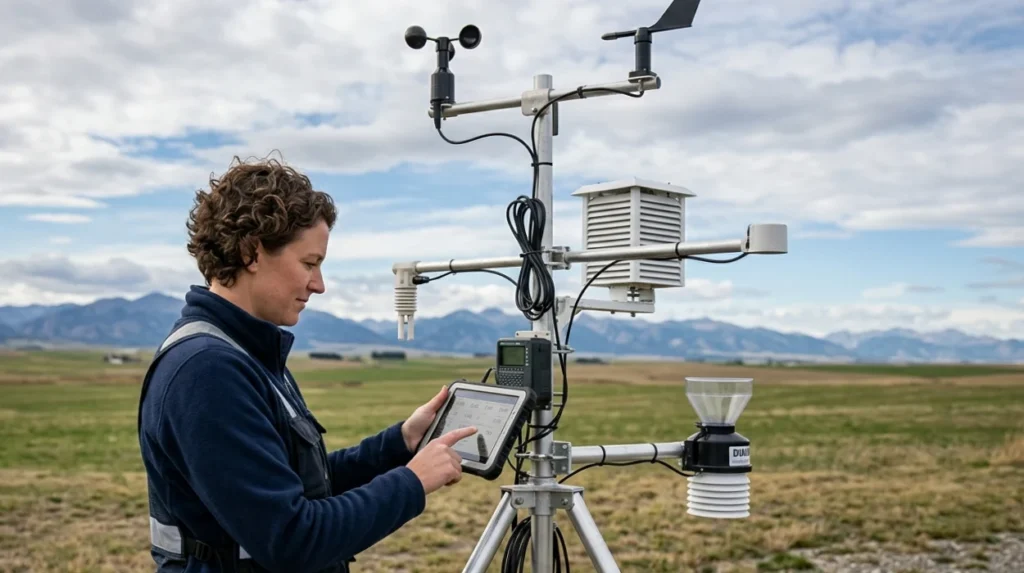
Meteorological tracking requires data collected across synchronized intervals worldwide. Surface measurement networks rely on Automated Weather Observing Systems. These systems integrate multiple sensors: digital thermistors for ambient temperature, capacitive hygrometers for relative humidity, piezoresistive barometers for pressure, and ultrasonic anemometers for wind velocity. These configurations eliminate human observation errors and transmit raw telemetry continuously.
Upper-air data collection relies on the deployment of radiosondes. Twice daily, at 00:00 and 12:00 Coordinated Universal Time, meteorologists launch these instrument packages via helium or hydrogen balloons. As the balloon ascends through the troposphere into the stratosphere, sensors transmit vertical profile data covering pressure, temperature, and moisture. GPS tracking of the balloon provides wind speed and direction data across various altitudes.
Remote sensing technologies scan areas between physical station points. Ground-based Doppler radar arrays emit microwave radiation pulses that reflect off hydrometeors, which are water droplets or ice crystals in the air. Measuring the power and frequency shift of the returned signals allows meteorologists to map precipitation intensity, track hail core development, and detect internal cloud rotation. Orbital tracking relies on two main satellite systems: geostationary satellites, which monitor localized storm dynamics from fixed orbits, and polar-orbiting satellites, which capture high-resolution global environmental profiles.
Modern forecasting uses numerical weather prediction models. Supercomputers ingest globally gathered observations and apply data assimilation algorithms to correct instrument errors, mapping the information onto a three-dimensional grid. The system solves the fundamental equations of atmospheric fluid dynamics, including the Navier-Stokes equations for momentum, the thermodynamic energy equation, and the continuity equation for mass conservation.
These calculations produce deterministic forecasts, but initial data gaps can introduce errors over time. To account for this chaos, meteorological institutions run ensemble forecasting. This technique runs a single model multiple times with slight variations in the initial data. If the resulting forecast outputs remain uniform across runs, the probability of the projected weather event is high. If the model outputs diverge rapidly, the forecast confidence decreases.
What are the socio-economic impacts of weather events?
Weather events dictate the operational structure of global agricultural systems, affect macro-transportation logistics, alter seasonal municipal energy demands, and present physical risks through extreme atmospheric conditions that require systemic economic mitigation.
Agricultural systems are closely linked to immediate weather conditions. Crop development depends on specific soil moisture levels, thermal accumulation indices, and frost-free periods. Drought events deplete soil moisture and lower crop yields. Conversely, excessive rainfall during harvest windows saturates soils, delaying machinery operations and causing root rot diseases, which can disrupt regional food supply chains.
The transportation sector relies on stable weather to maintain scheduling and safety margins. Aviation operations face limitations from low visibility, convective wind shear, and high-altitude icing conditions that freeze control surfaces. Marine shipping routes must adapt to avoid deep low-pressure systems that generate high wave heights. Trucking networks face delays from frozen precipitation, which increases accident risks and raises logistics costs.
Energy grids must adapt to weather shifts to balance generation against consumer demand. Summer heatwaves drive up electricity consumption due to air conditioning loads, testing grid capacity. Winter cold fronts trigger high demands for natural gas and electricity for space heating. Weather also directly affects renewable energy production, as solar output drops during prolonged cloud cover and wind turbines shut down during extreme gales to prevent structural damage.
Extreme weather events present substantial structural and financial challenges to global economies. Insurance organizations use historical meteorological data to price risk profiles for properties exposed to natural hazards. Major storms, floods, and wind events cause billions of dollars in structural damage annually. This requires substantial public investments in municipal infrastructure, including automated flood defenses, early warning systems, and reinforced electrical grids designed to withstand severe weather.
What is weather?
Weather is the short-term state of the atmosphere at a specific place and time, including temperature, humidity, wind, cloud cover, precipitation, and air pressure.