

Key Points
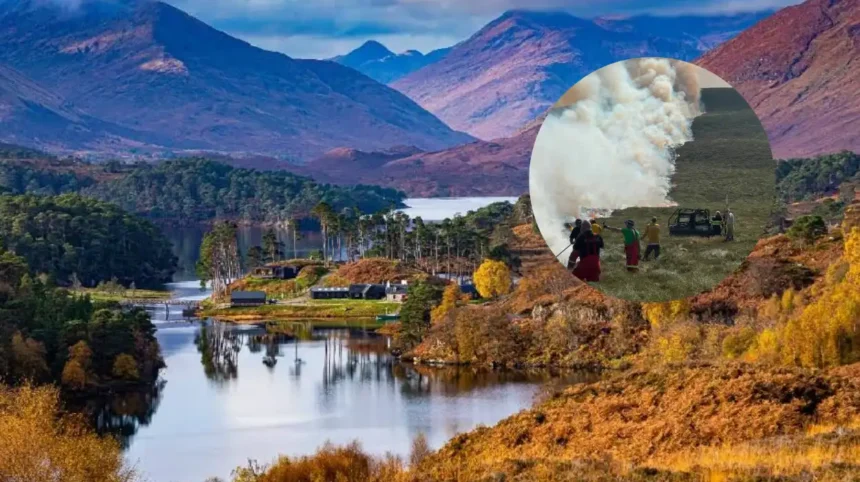
- The Cairngorms national park has been hit by a large wildfire that has burned for 12 days and left major areas unrecognisable.
- Hectares of land have been blackened, with smoke still rising from parts of the park and orange skies visible at night.
- Authorities say it could take weeks or months to fully extinguish the blaze, while the damage may take decades to repair.
- The fire has affected parts of the Caledonian pinewood forest, including areas with Scots pine trees around 300 years old.
- Most older forest was protected by fire breaks dug early in the emergency.
- Police Scotland said on Saturday night it was no longer treating the fire as a major incident.
- Residents of Nethy Bridge were evacuated on Friday night, but have now been told they can return home.
- More than 75 firefighters remained at the scene on Sunday, with helicopter water-bombing still essential.
- Three private helicopters were contracted to support firefighting, dropping about 750,000 litres of water a day on hotspots.
- The Scottish Green Party has called for publicly available firefighting aircraft during wildfire season.
UK (Liverpool standard) July 27, 2026 – The Cairngorms national park has been left scarred after 12 days of a wildfire that officials and local residents have described as the worst blaze the area has ever seen. As reported by Robyn Vinter of The Guardian, the fire has torn through moorland and forest, leaving hectares of blackened land visible once low cloud cleared on Sunday. Smoke continued to billow from still-burning ground, while the evening sky glowed orange above one of Scotland’s most treasured landscapes.
The reporting shows the scale of the damage in stark terms. Authorities say the fire is far from over, with the blaze expected to take weeks, if not months, to extinguish fully. Even where the fire is brought under control, the long-term recovery may stretch into decades, according to those involved in the response. The emergency has also raised fresh questions about how Scotland responds to remote wildfires in difficult terrain.
What damage has the fire caused?
The fire has already destroyed parts of the Caledonian pinewood forest, including areas that contain Scots pine trees around 300 years old. Forestry and Land Scotland planning manager for the north region Ian Allsopp said larger animals such as deer would likely have escaped, but smaller mammals, lizards, insects and ground-nesting birds would have perished. That means the environmental impact is not only visible in the scorched landscape, but also in the loss of rare habitat and wildlife.
Grant Moir, chief executive of the Cairngorms national park, said it was the worst fire the park had seen. He described the location as “such a precious place”, noting that the blaze sits in the centre of the Cairngorms, including the Cairngorm mountains and Abernethy. The Guardian reported that fire breaks urgently bulldozed into the land in the early days of the fire helped save most of the older forest. Even so, the area has suffered major ecological damage that could take a very long time to recover.
What is the response on the ground?
The firefighting effort remains large and coordinated. On Sunday, the Scottish Fire and Rescue Service said more than 75 firefighters were still on the scene, and officials said better weather, including heavy rain and low winds, had slowed the spread. Firefighters described the operation as intensive, but said conditions had improved enough to limit further movement of the flames.
Helicopters have become a critical part of the response because the Cairngorms are difficult to reach on foot. Three private helicopters were contracted to assist, dropping about 750,000 litres of water a day on wildfire hotspots. Allsopp said the companies’ help was “so lucky” because the blaze had become an “inferno”. He also said the landscape is extremely challenging, with steep mountains and forest making access difficult for ground crews.
Why are locals angry?
The emergency has caused frustration among some residents, especially after the fire was previously described as contained before strong winds made it worse. That shift led to the evacuation of Nethy Bridge village on Friday night, adding to local anxiety and distrust. Residents have since been told they can return home, but the experience has left a deep impression on the community.
Sandy McCook, a retired press photographer from the village, said the fire was “absolutely heartbreaking” and described the flames on Friday as “cataclysmic”. He argued the blaze may have been preventable and said a helicopter on government contract could have dealt with the fire much earlier. His comments reflect a wider local call for faster and more specialised response capability in remote parts of Scotland.
What have authorities said about the cause?
The cause of the fire remains unknown. However, the Guardian reported that the vast majority of UK wildfires have a human origin, and can begin from something as small as a discarded cigarette or abandoned glass bottle. That uncertainty has intensified concern among officials and local people, especially because the fire began in an area where summer campfires and barbecues have already been banned under a national park bylaw introduced in April.
Police Scotland said on Saturday night it was no longer treating the blaze as a major incident. Even so, the danger has not passed, and emergency teams remain focused on preventing the fire from spreading further. The presence of dry weather ahead means the situation could change again quickly, even after short periods of rain.
What is the wider political response?
The crisis has already prompted calls for stronger wildfire resources in Scotland. On Monday, the Scottish Green Party demanded publicly available firefighting aircraft during wildfire season. The party said Scotland “cannot continue to rely on a patchwork of private operators and borrowed resources”, arguing that a permanent capability would better protect vulnerable landscapes.
The UK government offered military support on Sunday, but said it did not have access to the specialist firefighting helicopters requested by the Scottish government. That gap has become part of the wider debate over how wildfire response should be organised in remote and environmentally sensitive areas. For many observers, the Cairngorms fire has exposed the limits of existing arrangements.
How did agencies work together?
Officials say the response has depended on close cooperation between multiple organisations. Forestry and Land Scotland, the Cairngorms national park authority, police, fire services, RSPB Scotland, Highland Council and both the Scottish and UK governments have all taken part in the effort. Allsopp said the collaboration had been effective and that teams had pooled skills and knowledge to keep up with the scale of the emergency.
He added that even accountants were helping with errands, including bringing water and sun cream to crews on the ground. His remark suggests the operation has stretched every part of the response network. The effort has been so demanding that, in his words, it has felt like “a war strategy”.
Background of the development
The Cairngorms national park is one of Scotland’s most famous landscapes and a major ecological site, so a wildfire of this scale is particularly significant. The emergency began in mid-July 2026 and quickly grew into what officials have described as the worst fire the park has ever experienced. The combination of remote terrain, dry ground, steep mountains and woodland made the blaze difficult to access and control.
Wildfires in the UK are often linked to human activity, which is why authorities already had summer restrictions on campfires and barbecues in place. The use of helicopters, fire breaks and a multi-agency response reflects the difficulty of fighting fires in mountainous country. The Cairngorms case has now become a test of whether existing wildfire planning is enough for increasingly severe conditions.
What could happen next?
For residents, the immediate effect is uncertainty, even after evacuations have ended and some people have been allowed home. For land managers, the fire may lead to years of restoration work, especially in damaged woodland and habitat areas. For local communities, the experience may increase pressure on governments to provide faster specialist aircraft and stronger prevention measures during future wildfire seasons.
For Scotland more broadly, this development may shape how wildfire response is funded and organised, especially in rural regions with limited access. It could also influence public debate over whether private helicopters and borrowed support are sufficient for increasingly dangerous summer fires. If dry weather returns before the site is fully extinguished, the emergency may remain active for some time and continue to expose the country’s firefighting limits.