Key Points
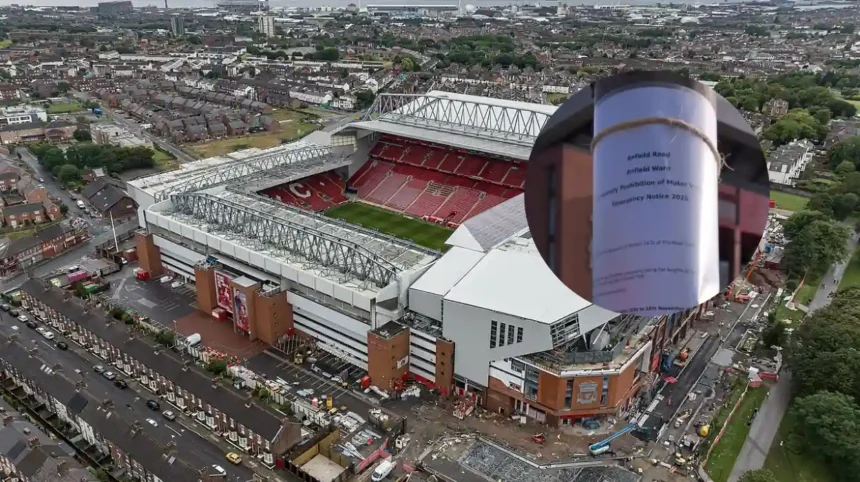
- On 12 October 2026, the Liverpool Echo stated that a road surrounding the Anfield Stadium had been closed. Liverpool FC explained that the closure of this particular area was not done by the club.
- From the available report summary, the particular section of road which was closed and the actual reasons why this section of road was closed are not mentioned. Neither is the body in charge of the decision making process.
- Liverpool FC also announced an update on travel ahead of their match against Manchester City on 11 October.
- Liverpool City Council Planning Committee stated in July that they were minded to reject the application by Liverpool FC to close part of Anfield Road to traffic. This was not a final decision.
Anfield (Liverpool standard) October 12, 2026 – Anfield stadium had closed suddenly, while Liverpool FC said the decision to close the section last week was not the club’s call. The available report summary does not name the specific section, give the precise closure time or reason, or identify which authority made the decision.
That distinction matters because the headline concerns a reported sudden closure, while Liverpool FC’s longer-running planning application concerns whether a section of Anfield Road should remain closed to motor vehicles permanently. The available information does not establish that the two developments are connected.
The full Liverpool Echo article could not be retrieved. As a result, the reporter’s name, any statements beyond the article summary, and accounts from residents or officials could not be independently checked. No further explanation is attributed to the Echo or Liverpool FC beyond the information available in the summary.
What travel disruption had Liverpool FC announced?
Liverpool FC published a travel update ahead of its home fixture against Manchester City on Sunday, 11 October. The club advised supporters to check their routes because of rail disruption and Liverpool City Council highway works.
According to the club’s notice, Merseyrail’s Northern Line between Hunts Cross and Liverpool was due to close for a month, from 11 October to 6 November. The update said there would be no Northern Line services to Liverpool city-centre stations during the works. It also described altered routes and replacement transport for passengers travelling towards Sandhills and Anfield.
The same notice said council work on Walton Breck Road would continue until March 2027. It described a single-lane carriageway arrangement, with traffic running in one direction from Oakfield Road towards the city centre. The club also stated that the usual matchday closure arrangements would apply, with Walton Breck Road closed two hours before kick-off and for one hour after the final whistle.
The club’s travel notice provides relevant context for people travelling around Anfield, but it does not establish that Walton Breck Road or the Merseyrail disruption was the sudden road closure described in the Liverpool Echo report. The available information does not make that link.
Why has part of Anfield Road been disputed?
The separate planning dispute relates to a section of Anfield Road between Alroy Road and Skerries Road. It was closed to motor vehicles in 2021 while Liverpool FC expanded the Anfield Road Stand. A replacement road was constructed between the stand and Stanley Park, but the section has not reopened to cars; it remains available to pedestrians and cyclists except during matches and major events.
The original planning arrangement required the replacement road to open to motor vehicles when the new seats in the stand were first used, according to the BBC’s July report. Liverpool FC later sought permission to keep the road permanently closed to vehicles. The club’s application argued that reopening it would create safety risks around the stadium.
Liverpool City Council’s planning committee considered that application in July 2026. Councillors said they were “minded to refuse” it, despite planning officers having recommended approval. The committee’s position was not a formal refusal: the application was expected to return for a final decision.
What did the club and residents say?
The BBC reported that Liverpool FC’s application cited risks to pedestrians and the possibility that opening the road would leave part of the stadium perimeter without barriers against a vehicle attack. Counter Terrorism Policing North West supported keeping the section closed, according to the same report.
Sam Ryan, a planning consultant representing the club, told the committee that a safety audit had concluded the road could reopen to vehicles if signage and road markings were installed. She also argued that Anfield’s status as a high-visitor site and the heightened terror threat supported retaining the closure. The BBC reported that she described reopening the road as creating the stadium’s “only weak point”.
Residents raised different concerns. The BBC reported that some said the closure had pushed traffic onto nearby streets. Sixth-form student Savannah Shellard told the committee that Walton Breck Road had become busier and harder to cross after she got off the bus. She said getting home could feel “quite intimidating”.
Councillors cited traffic flow, effects on residents and environmental nuisance among the grounds for proposing refusal. Planning officers, however, said the effects on traffic levels and journey times were not serious enough to make the closure unacceptable. Air-quality specialists judged the predicted effect on air quality not significant.
Anfield ward councillor Billy Marrat proposed that the section could close on match and event days but open at other times. A Liverpool Echo report published in July also recorded differing views among residents and supporters, including concerns about safety, traffic and whether the club had honoured earlier expectations that the road would reopen. That report concerned the long-term planning proposal, not necessarily the sudden closure mentioned in the 12 October headline.
Background
The Anfield Road Stand expansion led to the closure of the relevant road section in 2021. Although the construction work was completed in 2024, the section remained closed to motor vehicles, and Liverpool FC pursued planning permission to make that arrangement permanent.
The proposal became contentious because the club emphasised security and pedestrian safety, while some residents and councillors argued that the closure affected local traffic and community access. The council committee’s July position was preliminary rather than final.
The sudden closure mentioned in the later Liverpool Echo headline should not be confused with that ongoing planning process unless further reporting confirms a connection. The information available does not identify the responsible authority or reason for the reported closure last week.
What could the development mean for residents and supporters?
For residents and people travelling to Anfield, a confirmed temporary closure could affect access, traffic routes and journeys around the stadium. However, the available information does not confirm the location or duration of the sudden closure, so its specific impact cannot be reliably assessed.
Supporters should distinguish the reported sudden closure from Liverpool FC’s published matchday travel arrangements and the separate planning application concerning Anfield Road. The club’s 10 October notice set out planned rail and Walton Breck Road disruption for the Manchester City fixture, while the Liverpool Echo headline summary reported a separate road closure that the club said was not its decision.