
Key Points
- The lunar eclipse will be visible across Merseyside during the early hours of Friday, 28 August 2026.
- The penumbral phase begins at 02:23 BST, followed by the visible partial umbral eclipse at 03:33 BST.
- Maximum coverage occurs at 05:12 BST, when up to 93 per cent of the Moon’s surface will be in the Earth’s shadow.
- The Moon is due to set shortly after 06:15 BST in the North West, before the final stages of the eclipse end below the western horizon.
- Stargazers will need a clear west-southwest horizon and suitable weather conditions to see the eclipse before daybreak.
Liverpool (Liverpool standard ) August 27, 2026 – A rare astronomical spectacle will grace skies across Merseyside on Friday morning, offering residents a clear sight of a deep partial lunar eclipse across all local boroughs. The alignment places the Earth directly between the Sun and the Moon, projecting a massive shadow across the lunar disc in the pre-dawn hours.
What Time Does the Liverpool Lunar Eclipse Begin and Peak?
The celestial sequence starts at 02:23 BST when the Moon enters the outer penumbral shadow. Observers will notice the main event beginning at 03:33 BST as the lunar disc enters the dark umbral core, creating the appearance of a bite taken from the edge.
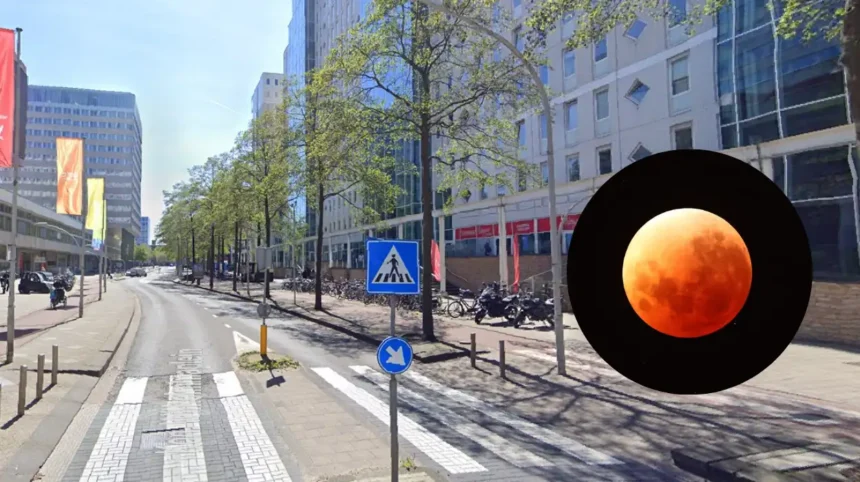
Maximum eclipse occurs across all Liverpool postcode zones at 05:12 BST. At this peak, approximately 93 percent of the Moon will sit within the direct shadow of the Earth, taking on a reddish or dusky hue before descending beneath the horizon around 06:20 BST.
As reported by astronomy specialists at the Royal Observatory Greenwich, the alignment presents significant coverage: “The partial phase of the lunar eclipse will begin at 3.33am BST, when the Moon starts moving into Earth’s umbra… with roughly 93% of its visible surface in the darkest part of the shadow.”
| Stage | Merseyside Time (BST) | Astronomical Description |
|---|---|---|
| Penumbral Start | 02:23 | Moon enters the faint outer shadow |
| Umbral Contact | 03:33 | Distinct dark shadow begins covering the surface |
| Maximum Peak | 05:12 | Deepest coverage reaches approximately 93 percent |
| Local Moonset | ~06:20 | Moon sinks below the horizon in Liverpool |
| Final Phase Exit | 06:51 | Event concludes after the Moon has set locally |
Which Merseyside Postcodes Have the Best Visibility?
Timings for astronomical eclipses occur simultaneously across every postcode in Liverpool, Sefton, Knowsley, St Helens, and the Wirral, though landscape obstructions affect viewing quality. Because the maximum phase happens low in the west-southwest sky, elevation and open lines of sight remain critical.
text┌─────────────────────────────────────────────────────────────┐
│                   MERSEYSIDE POSTCODE MAP                   │
│                                                             │
│   [ L37 / L39 ]          [ L31 / L10 ]        [ WA9 - WA11 ]│
│   Formby / Ormskirk      Maghull / Aintree    St Helens     │
│   (Coastal Dunes)        (Open Fields)        (Elevated)    │
│                                                             │
│   [ L1 - L8 ]            [ L15 - L19 ]        [ CH41 - CH49]│
│   City Centre / Docks    Sefton Park / S.Lpl  Wirral Coast  │
│   (Otterspool Prom)      (Parkland Clearings) (New Brighton)│
└─────────────────────────────────────────────────────────────┘
Coastal stretches in Crosby (L23), Formby (L37), and the Wirral promenade (CH44, CH45) offer unbroken sea horizons facing west. Elevated zones in Woolton (L25) and Billinge Hill near St Helens (WA11) provide higher vantage points above rooflines and low-level urban mist.
How Should Stargazers Prepare for Optimal Viewing?
Unlike solar events, a lunar eclipse requires no specialist filters or protective eyewear and remains safe to view directly. Clear weather, minimal light pollution, and high vantage points will provide the best experience.
- Check local meteorological updates for overcast conditions or marine cloud cover rolling off the Irish Sea.
- Travel to open areas such as the Otterspool Promenade, Southport Beach, or Everton Park to avoid high buildings.
- Set up optical gear such as standard binoculars or small telescopes by 03:15 BST to track the umbral progression.
- Allow 20 minutes in dark conditions for eyes to adapt before the maximum phase at 05:12 BST.
Background of This Astronomical Event
A lunar eclipse occurs when the orbital paths of the Earth, Sun, and Moon intersect along syzygy nodes during a full moon phase. When alignment is near-complete but imperfect, the Moon slips partially into the central umbral shadow rather than undergoing total obscuration.
The characteristic coppery appearance seen during deep partial eclipses stems from Rayleigh scattering through the atmosphere of the Earth, which bends longer red wavelengths of sunlight into the shadow cone. The August 28 event represents one of the deepest partial alignments observable from the British Isles until the next total lunar eclipse visible across Europe.
Prediction for Skywatchers and Local Tourism
The pre-dawn schedule on a Friday morning will encourage substantial engagement among amateur astronomy groups, night photographers, and local coastal visitors throughout Merseyside.
Locations offering panoramic western horizons—such as the New Brighton waterfront and Formby Point—are likely to see increased early-morning visitors before normal commuting hours. If clear skies prevail over the North West, the visual impact of a near-total red moon setting over the Irish Sea will produce widespread public interest and high photographic engagement across regional media networks.