

Key Points
- Wirral Council has reiterated its “steadfast opposition” to the proposed Peak Cluster carbon dioxide (CO₂) pipeline through the borough.
- Emergency planning and associated costs in the event of pipeline incidents would rest with local councils, in collaboration with Peak Cluster.
- Council leader Paula Basnett said the authority would continue to prioritise residents’ safety and ensure emergency arrangements meet legal requirements if the project proceeds.
- Campaigners, including Action Against Carbon Capture Storage (AACCS), warn that the specialist nature of CO₂ pipeline risks could impose significant training and equipment costs on local authorities.
- The Peak Cluster scheme aims to transport captured CO₂ from cement and lime plants in the Peak District through Cheshire and Wirral for storage under the Irish Sea.
- Hundreds of residents have protested outside Wallasey Town Hall, with petitions and online groups gathering tens of thousands of signatures against the project.
- Peak Cluster maintains the pipeline will be designed to recognised standards and regulated by the Health and Safety Executive (HSE), with safety as its “top priority”.
Wirral Council (Liverpool standard) August 07, 2026 – Opposition to the Peak Cluster carbon capture and storage (CCS) pipeline has intensified after it emerged that emergency planning and related costs for any incidents would fall to local councils working alongside the project operator. uk/local/wirral-council/">Wirral Council, which has consistently opposed the scheme, says it will continue to put residents’ safety first and ensure emergency arrangements comply with legal obligations should the project advance.
- Key Points
- What are the safety and emergency planning concerns over Peak Cluster?
- How have residents and campaigners responded to the pipeline proposal?
- What is the Peak Cluster project and what do operators say about safety?
- Background to the Peak Cluster development
- Predictions: how this development could affect Wirral residents and local authorities
What are the safety and emergency planning concerns over Peak Cluster?
Opposition to the Peak Cluster carbon capture and storage (CCS) pipeline has intensified after it emerged that emergency planning and related costs for any incidents would fall to local councils working alongside the project operator. Wirral Council, which has consistently opposed the scheme, says it will continue to put residents’ safety first and ensure emergency arrangements comply with legal obligations should the project advance.
Council leader Paula Basnett said:
“Wirral Council has made extremely clear its steadfast opposition to the proposed Peak Cluster pipeline through the borough and this has not changed.”
She added:
“This council will continue to put the needs of residents first, ensuring their safety and protection whatever the outcome of the ongoing Peak Cluster consultation.”
Basnett further stated:
“Should the project progress, the council would ensure appropriate emergency planning arrangements are in place in accordance with legal requirements.”
David Parkin, chief executive of Peak Cluster, said: “Every local authority in the country is responsible for managing the impact of any major incident within its area – from a traffic incident to a wildfire.” He continued: “As with other pipelines in the country, authorities must have an emergency plan in the event of an incident occurring, and operators, such as Peak Cluster, must develop plans for securing the safety of their infrastructure.” Parkin added:
“Wirral Council – via the Merseyside Resilience Forum – already has plans for managing many potential incident risks including pipelines.”
He said:
“Peak Cluster would work in collaboration with the local authorities to extend their plan.”
Laura Beveridge-Muircroft, chair of campaign group Action Against Carbon Capture Storage (AACCS), said: “Technically, it’s always the local authority’s responsibility for the emergency plan, but the issue we have is it’s an exceptionally new and specialist area and therefore the cost of training and equipment will fall to local authorities.” She added:
“We have no clue what PC will offer in terms of financial support or what the long term costs are for residents.”
Beveridge-Muircroft noted:
“Somewhere like ESSAR have their own emergency response on site because of how specialised and dangerous it is there.”
How have residents and campaigners responded to the pipeline proposal?
Opposition to the pipeline has been mainly concentrated in Wirral, where residents and landowners have raised environmental, economic and safety concerns. Other opposition groups are emerging along the pipeline route. Campaigners argue the project would cause “irreversible” damage to rural areas, threaten livelihoods, and harm biodiversity, all in support of a technology they describe as “unproven” and “high risk”.
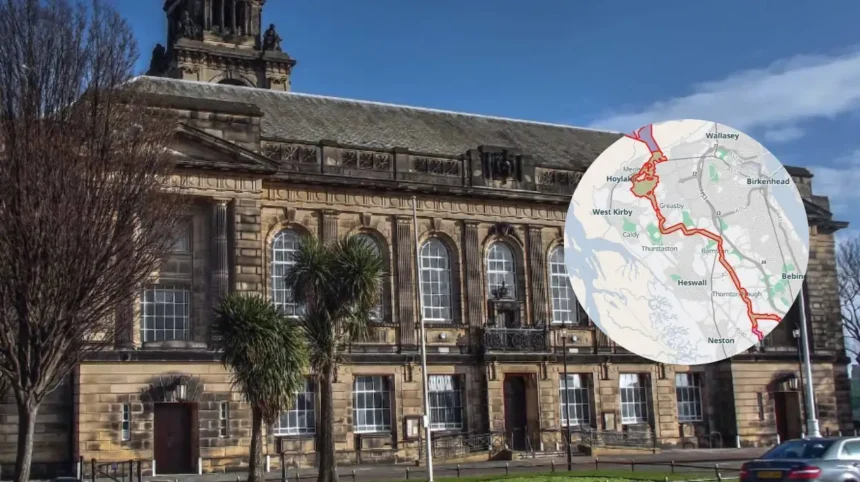
Hundreds of demonstrators gathered outside Wallasey Town Hall prior to an extraordinary general meeting of Wirral Council, leading to a consensus that council leader Paula Basnett would convey cross-party concerns to the government. Councillors from all factions within the Labour-led authority expressed that the scheme poses a threat to the scenic beauty and coastline of Wirral. Residents along the pipeline’s route have expressed their discontent, with nearly 17,000 individuals signing a petition against the project.
Hundreds of local residents gathered in protest outside a town hall against the proposed 160-mile carbon capture pipeline that would run through Cheshire and the Wirral. Locals have been critical of the project over worries it could ruin natural landscapes and harm wildlife.
Public opposition has been substantial, with approximately 12,000 signatures on a Wirral Reform petition and nearly 8,000 members joining a Facebook group against the project. Labour’s council leader Cllr Paula Basnett has insisted the push is not politically motivated. She said:
“I want to be clear that this is not about politics, nor is it about going against government policy.”
Basnett added:
“This is about the health and safety of our residents.”
Protesters gathered in their hundreds outside Wallasey Town Hall ahead of an extraordinary meeting called by Wirral Council to debate the major carbon capture scheme. Wirral Council leader Cllr Paula Basnett has also asked to meet with government minister Ed Miliband, urging the government “to give full and serious consideration to the views of our residents and our communities”. She added: “Infrastructure designed to support the transition to net zero will only succeed if it carries public confidence.” Basnett continued: “Proceeding with a route that is widely opposed and perceived as unsafe risks undermining that confidence and damaging trust in the wider decarbonisation agenda.”
On Peak Cluster, Basnett added: “In the event of a leak, we know that pets and children are affected first, one of the reasons being they are closer to the ground.” She asked: “What happens then, when our babies, when our children, when our future ends up in a situation when their safety is compromised for the sake of so-called progress.”
One Wirral councillor said they are with the public and “completely and utterly against this nonsense”. Councillors’ fury and protesters accused Peak Cluster of being “evasive, dismissive, and utterly disrespectful”.
What is the Peak Cluster project and what do operators say about safety?
The £60 million Peak Cluster project aims to capture carbon dioxide (CO₂) emitted from cement and lime facilities in the Peak District, transporting it through a pipeline in Wirral to be stored beneath the ocean. The project, described by a councillor as an “eyesore”, would see emissions stored in the Irish Sea. The Peak Cluster Project aims to transport carbon dioxide emissions from four cement and lime manufacturers in the Peak District, with plans to store the emissions under the Irish Sea.
A councillor expressed significant concerns regarding the use of new technology, citing past incidents in the US, China, and other parts of Europe where similar technologies have failed. He warned: “CO₂ is a dense gas, so if it leaks, it will accumulate in residential areas where people live and where wildlife exists.” He added: “We will be subject to regulation by the Health and Safety Executive, just like all other gas pipelines, under the same standards.”
Jeff Green, who leads the Conservative faction on Wirral Council, remarked that “valid apprehensions about our environment, ecosystems, and health and wellness have been disregarded”. His remarks followed the government’s reply to a petition, in which it indicated that there were no intentions to halt the project.
Peak Cluster states on its website: “Our engineering design meets recognised standards and regulations, established best practice and proven design methods and robust control safety measures to ensure risks are minimised to levels accepted by the Health and Safety Executive and the Environment Agency.” The operator adds: “As with UK’s high-pressure natural gas pipelines, the Peak Cluster CO₂ pipelines are being designed to BS PD8010 standards.” These standards ensure the pipeline design considers an extensive list of risk factors including corrosion risk, third party damage, proximity to communities, flooding, ground movement and so on.
Peak Cluster further states: “Importantly, this announcement does not change Peak Cluster’s approach.” It adds:
“Our carbon dioxide pipeline has always been designed to meet MAHP standards.”
The operator says:
“The HSE’s decision therefore confirms the robust safety framework that our project has already adopted.”
Peak Cluster concludes:
“Safety is our top priority.” It adds:
“From design and construction through to operation, Peak Cluster is committed to the highest standards and we are fully confident that our pipeline will be delivered and operated safely.”
Background to the Peak Cluster development
The Peak Cluster scheme is part of wider UK efforts to deploy carbon capture and storage (CCS) as a tool for decarbonising heavy industry. The project proposes to capture CO₂ from cement and lime plants in the Peak District and transport it via a high-pressure pipeline through Cheshire and Wirral to depleted gas fields under the Irish Sea for permanent storage. The pipeline route has been estimated at around 160–200km (100–124 miles), passing near residential areas and green belt land.
Public opposition has been sustained since early 2026, with large protests at Wallasey Town Hall, petitions gathering tens of thousands of signatures, and active online campaigns. Wirral Council has held extraordinary meetings to debate the scheme, with motions calling for the project to be cancelled or rerouted away from the peninsula. Council leaders have written to Energy Secretary Ed Miliband setting out cross-party objections and urging the government to reconsider the route.
Safety debates have focused on the behaviour of CO₂ in the event of a leak. Critics note that CO₂ is colourless, odourless and heavier than air, meaning leaked gas can accumulate in low-lying areas and pose asphyxiation risks, particularly to children and animals closer to the ground. Supporters and the operator emphasise that the pipeline would be regulated by the HSE and designed to recognised British standards for high-pressure pipelines.
Predictions: how this development could affect Wirral residents and local authorities
If the Peak Cluster pipeline proceeds in its current form, Wirral residents and local authorities are likely to face heightened scrutiny over emergency preparedness and long-term liability. The expectation that councils will lead emergency planning, in collaboration with the operator, could require additional training, equipment and coordination with the Merseyside Resilience Forum. Campaigners warn that the specialist nature of CO₂ incidents could impose significant costs on local authorities, with unclear commitments from Peak Cluster on financial support.
For residents, the presence of a high-pressure CO₂ pipeline near homes and green spaces could affect perceptions of safety, property values and willingness to support future net-zero infrastructure in the area. If leaks or incidents occur, even rarely, the consequences for nearby communities could be severe, given the gas’s tendency to settle close to the ground. Conversely, if the project is delivered without major incidents and with robust monitoring, it could become a reference case for how CCS infrastructure is governed and insured in the UK.
For Wirral Council, the dispute places local leaders at the centre of a national debate over how decarbonisation projects balance climate goals with local consent and safety. Continued opposition may strengthen the council’s negotiating position on emergency planning resources, community benefits and route alternatives, but could also create tension with central government if the project is designated as nationally significant infrastructure. The outcome will likely influence how future CCS schemes engage with communities along proposed routes across England.