

Key Points
- The Incident: A man in his 20s was left unconscious following an unprovoked, racially aggravated serious assault at a major intersection in Liverpool city centre.
- The Injuries: The victim suffered a fractured skull and a severe brain injury, which has resulted in a permanent or long-term speech impediment following a two-week hospitalisation.
- The Suspect: Before delivering the punch, the offender reportedly subjected the victim to a highly offensive racial slur. Detectives are treating the attack as a hate crime.
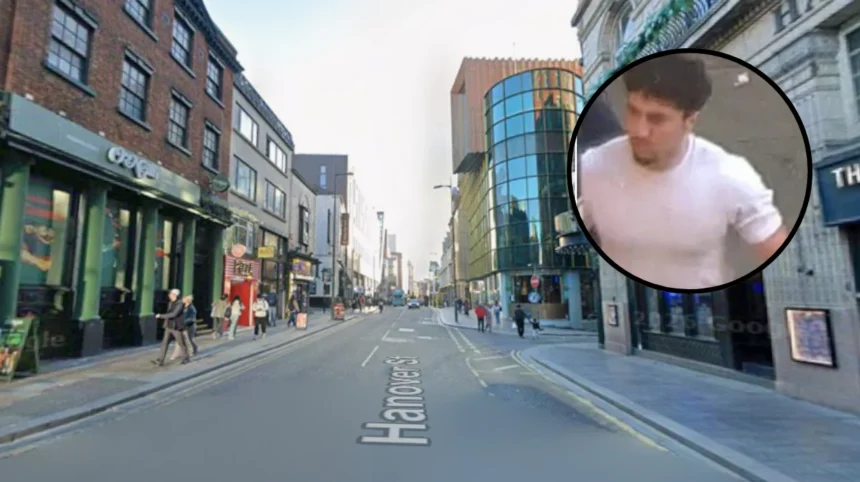
- The Appeal: Merseyside Police have released CCTV images of a man they urgently need to identify, believing he holds vital information that could progress the investigation.
- The Authority Statement: Detective Inspector Joe Rea has condemned the “dangerous and reckless” attack, reiterating the force’s absolute zero-tolerance policy toward hate crime across Merseyside.
Liverpool (Liverpool Standard) June 16, 2026 – Detectives from the Merseyside Police force have officially released closed-circuit television (CCTV) images of a man they believe possesses crucial information regarding a racially motivated serious assault in the heart of Liverpool city centre. The incident, which took place in the early hours of the morning, left a young man in his 20s with life-altering brain injuries after he was struck unconscious on a public street. Police are treating the matter with the utmost urgency, combing through forensic, witness, and digital evidence to track down the perpetrator responsible for the unprovoked attack.
- Key Points
- What Happened at the Junction of Fleet Street and Hanover Street?
- Why Is Merseyside Police Treating This Incident as a Hate Crime?
- What Did Detective Inspector Joe Rea Say About the Assault?
- How Have Extensive CCTV and Witness Enquiries Progressed the Case?
- What Legal Penalties Face the Perpetrator Under UK Law?
- How Can Members of the Public Report Information Safely?
The emergency services response was initiated at approximately 6:30 am on Saturday, 23 May, when paramedics from the North West Ambulance Service discovered the unresponsive victim at the busy junction of Fleet Street and Hanover Street. Immediate medical intervention was required at the scene before the young man could be blue-lighted to a local trauma centre. Initial reports compiled by emergency responders and subsequently confirmed by police investigators indicate that the assault was preceded by a brief verbal confrontation, during which the offender directed an explicit racial slur at the victim before delivering a single, devastating punch directly to his face.
The physical consequences of the assault for the victim have been described by medical professionals and authorities as catastrophic. The force of the blow caused the man to lose consciousness immediately, leading to a complex skull fracture and a severe traumatic brain injury. The victim required a critical two-week stay in a hospital high-dependency unit to stabilise his condition. While he has since been discharged from the hospital, the long-term prognosis remains severe, as the brain injury has left him with a pronounced speech impediment that will require ongoing therapeutic support.
What Happened at the Junction of Fleet Street and Hanover Street?
As detailed in the initial incident logs compiled by law enforcement, the geographic focus of this investigation is the bustling nightlife district of Liverpool, specifically the intersection where Fleet Street meets Hanover Street. At 6:30 am, a time when daytime commuters begin to mix with late-night revellers, the North West Ambulance Service was dispatched following reports of a member of the public lying motionless on the pavement.
According to situational reports published by regional crime correspondents, the area is heavily monitored by municipal and private security cameras due to its high density of bars, restaurants, and retail establishments. Witnesses at the scene reported seeing a brief interaction between two males before the violence erupted. The sudden nature of the attack gave the victim no opportunity to defend himself, resulting in him falling heavily onto the ground, which standard medical literature notes often compounds head injuries due to the secondary impact with the concrete pavement.
Why Is Merseyside Police Treating This Incident as a Hate Crime?
The classification of the assault as a hate crime fundamentally changes the legal framework and severity of the ongoing investigation. Under British law, a hate crime is defined as any criminal offence perceived by the victim or any other person to be motivated by hostility or prejudice based on a person’s race, religion, sexual orientation, disability, or transgender identity.
In this specific case, verbal evidence gathered from bystanders indicates that the perpetrator deliberately weaponised a racial slur immediately before launching the physical strike. This direct link between racial hostility and physical violence has led detectives to place hate-motivation at the absolute forefront of their operational theories, though they maintain that no potential avenues of inquiry are being closed off prematurely.
Explore More uk/crime/liverpool-city-centre-crime/">Liverpool City Centre Crime News
Jack Dixon Charged Manslaughter After Liverpool City Centre Death 2026
Missing Teen Went on to Lead ‘Jack Line’ County Line Gang
What Did Detective Inspector Joe Rea Say About the Assault?
In an official briefing released to the media, Detective Inspector Joe Rea of the Merseyside Police targeted both the severity of the crime and the necessity of community cooperation. As reported by crime editor Jonathan Humphries of the Liverpool Echo, Detective Inspector Joe Rea stated that
“This was a dangerous and reckless attack, which left the victim seriously injured from the unprovoked attack.”
The detective’s choice of words highlights the volatility of the incident, which law enforcement officials believe could easily have resulted in a fatality.
The long-term human cost of the assault was further underscored by the leadership team managing the case. As recorded by the police media bureau, Detective Inspector Joe Rea stated that
“The victim required extensive hospital treatment, and he now has a speech impediment from his brain injury.”
This direct connection between the single punch and a permanent physical disability forms the basis of the “serious assault” charge that the perpetrator will face upon apprehension.
Focusing heavily on the ideological motivation behind the violence, Detective Inspector Joe Rea stated that
“We believe this incident to be racially motivated, however we are exploring all lines of enquiry and would appeal to anyone who information to please contact us.”
The statement confirms that while the hate crime element is a primary line of investigation, the force is remaining methodical, ensuring all contextual factors surrounding the event are fully documented.
Appealing directly to the public conscience and the media network, Detective Inspector Joe Rea stated that
“Our enquiries are ongoing, and we are determined to find the person responsible.”
He followed this with a direct message regarding the digital evidence:
“I am appealing to the man featured in the CCTV footage, or anyone who recognises him to come forward. We believe he could hold information that could be vital to our continuing enquiries.”
Concluding his address, Detective Inspector Joe Rea stated that
“In Merseyside, we believe that everyone should be able to live their lives without fear of being subjected to verbal or physical abuse.”
This broader societal message was coupled with a systemic reassurance to minority communities across the region, as Detective Inspector Joe Rea stated that
“We are committed to tackling hate in our communities and would strongly encourage all victims to come forward and report such incidents.”
How Have Extensive CCTV and Witness Enquiries Progressed the Case?
In the weeks following the May 23rd attack, a dedicated team of plainclothes and uniformed officers have been engaged in an exhaustive evidence-gathering operation. Standard police protocols for major assaults involve the mapping of all operational CCTV cameras within a half-mile radius of the crime scene. This includes transport hubs, private businesses, and Liverpool City Council monitoring stations.
As noted by security analysts reviewing the case file, the release of high-clearance still images from CCTV footage is typically a calculated measure taken when initial localized database checks—such as checking images against the National Computer (PNC)—do not yield an immediate match. By placing the image into the public domain, the police aim to leverage local knowledge, hoping that friends, employers, or family members will recognise the clothing, posture, or facial features of the individual pictured.
What Legal Penalties Face the Perpetrator Under UK Law?
Should the individual responsible be apprehended and convicted, the legal ramifications are severe. In the United Kingdom, a serious assault that results in a skull fracture and permanent brain damage is typically prosecuted under Section 20 or Section 18 of the Offences Against the Person Act 1861, representing Grievous Bodily Harm (GBH).
Furthermore, because this offense carries a confirmed statutory aggravating factor—namely, the racial motivation—the sentencing guidelines dictate a significantly harsher penalty. Under the Crime and Disorder Act 1998, sentences for racially aggravated offenses must be increased by the judiciary. For a standard Section 20 GBH charge, the maximum sentence can be elevated from 5 years to up to 7 years imprisonment, while a Section 18 charge carries a maximum penalty of life imprisonment, with the racial element heavily influencing the minimum tariff served.
How Can Members of the Public Report Information Safely?
Merseyside Police have established multiple secure channels through which individuals can submit tips without compromising their personal safety. The force operates a fully staffed digital desk available 24 hours a day to handle incoming public communications.
Members of the public who recognize the individual in the CCTV footage or who were present in the Fleet Street and Hanover Street area between 6:00 am and 7:00 am on Saturday 23 May are urged to contact the police using the following official options:
- Direct Digital Reporting: Information can be sent via a direct message on social media to the specific handle @MerPolCC on Twitter/X, or via the official ‘Merseyside Police Contact Centre’ page on Facebook.
- Standard Police Lines: Individuals can call the non-emergency police number 101, quoting the specific crime reference log numbers allocated to the May 23rd assault.
- Anonymity Guaranteed: For those who wish to provide vital details without disclosing their identity, the independent charity Crimestoppers runs a dedicated, 100% anonymous hotline at 0800 555 111. Information can also be submitted through their secure online form at crimestoppers-uk.org.